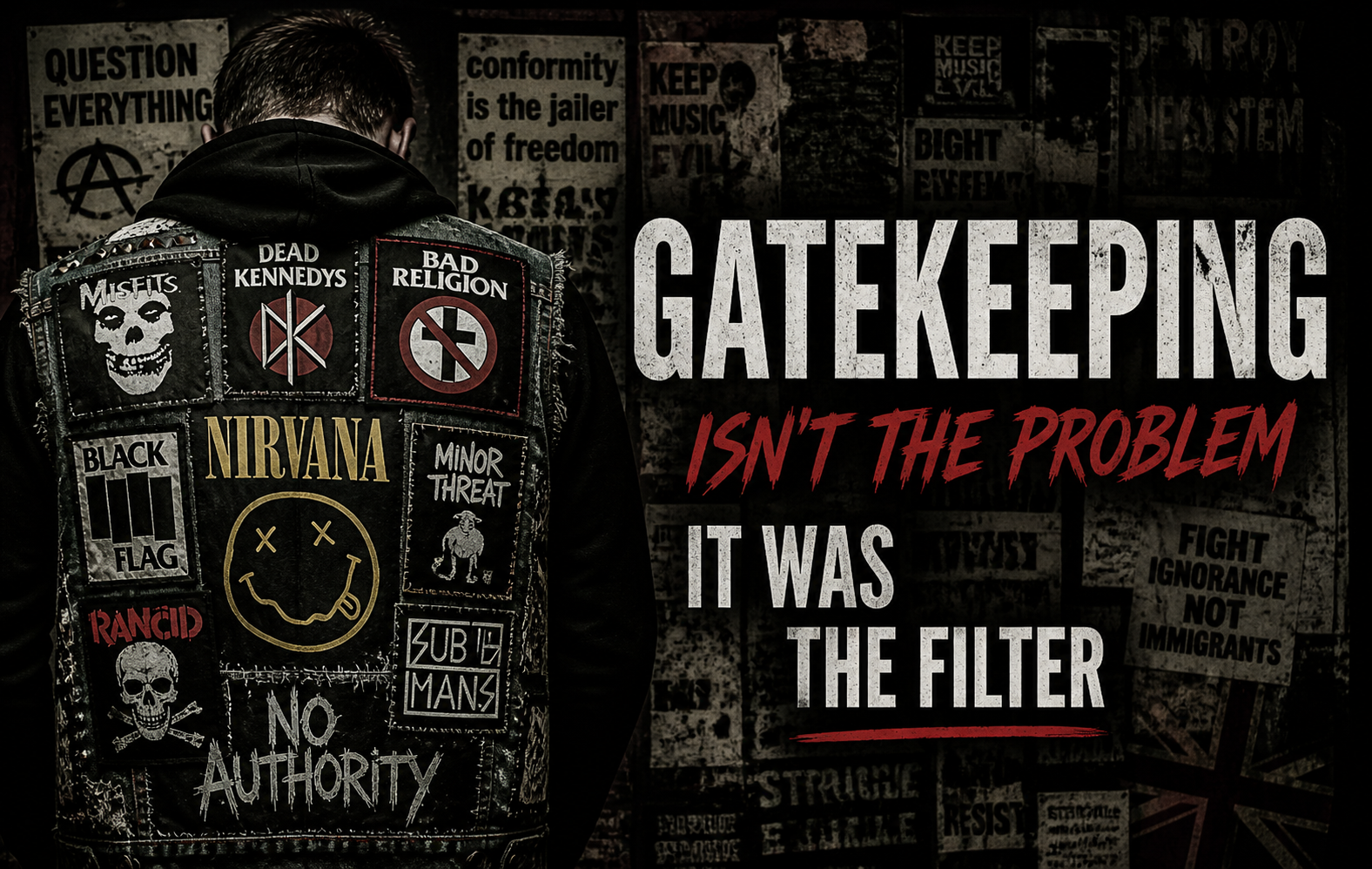
Gatekeeping, Posers, and the Collapse of Subculture
I’m a millennial… which means I grew up in a time where being a poser actually mattered. Something that goes unaddressed today.
When I was younger, you would have gotten bullied for being fake. “The hip” used to gatekeep music and political subcultures and you had to prove you were actually part of it.
When Authenticity Was Enforced
Subcultures used to have boundaries. Music scenes, political movements, even niche hobbies. If you said you were part of something, there was an implicit expectation:
you could back it up.
- You knew the bands
- You understood the ideas
- You could explain *why- you were there
If you couldn’t… you got called out. and not always politely. But it worked.
Gatekeeping wasn’t about exclusion. It was about coherence.
Everything was vetted, everything was legit.
The Shift
Somewhere along the line, that mechanism disappeared. What replaced it wasn’t broader access… it was surface-level participation.
Later millennials and everything after leaned into this fully. People didn’t need to understand something to belong to it anymore. They just needed to look like they did.
- aesthetics replaced substance
- signalling replaced understanding
- identity replaced participation
The result:
subcultures stopped being cultures… and became costumes.
The Rise of Performance
Once appearance becomes the entry requirement, everything downstream changes. This is where the “poser” stops being called out… and starts becoming the norm.
People become obsessed with how they are perceived. But can’t articulate why they like what they like… or believe what they believe. Belief becomes secondary and consistency becomes optional.
What matters is:
- how it looks
- how it’s received
- how it positions you socially
This creates a feedback loop:
the audience becomes the reference point.
Not truth, not out of principle, or not even personal taste. Just perception.
I don’t really understand the point of this.
Hollowing Out the Structure
When enough people engage at that level, the structure itself starts to degrade. Subcultures rely on shared standards. Remove those… and the identity still exists, but the meaning doesn’t.
Punk got co-opted. Goth got co-opted.
Same pattern every time.
They move in… adopt the aesthetic… strip out the substance… then move on.
Like locusts.
- Punk without rebellion
- Goth without introspection
- Activism without risk
They keep the form. They lose the function.
Example: Symbol Without Substance
Lets use Nirvana as the big example:

The logo is everywhere.
People say they love it… but in a lot of cases have never even listen to the band. So what do they actually love?
Not the music. Not the message.
The perceived “coolness”.
It’s become so normal that the detachment is unconscious. The denial is built in.
The same thing applies to Rage Against the Machine. I used to love them because they stood for something.
Now it feels like the image is louder than the substance… which is exactly the problem.
Tom Morello is one of the biggest posers, and the sad part is… That he used to be the costume that he is wearing.
RATM were always left-wing, but since the goalposts have gotten moved everything that they stood for now sits in the middle. Once that layer was ignored, All that is left is branding.
They are still using their message but it is all out of context, and in some ways being used to support the very things they stood against in the first place.
I still love the music and probably always will, but I am ashamed of what they have become.
Tattoos Have Become Surface-Level
Tattoos used to mean something. They were permanent… so the decision carried weight:
- identity
- experience
- commitment
Now the same symbols are picked like menu items. Fandom… subculture… ideology… Flattened into aesthetics.
What used to be representation*- is now **flash art. You don’t need to stand over it. You just need to like how it looks.
What Was Gatekeeping Actually Doing?
Gatekeeping gets framed as elitism. Sometimes it was. But that’s not the full picture.
At its core, it acted as:
- quality control
- cultural memory
- meaning preservation
It forced a basic question:
Do you actually care about this… or just how it looks?
Without that question, everything trends toward dilution.
The Trade-Off
Removing gatekeeping feels inclusive. In practice, it trades:
- depth → accessibility
- meaning → scale
That’s fine… if the goal is reach. But if the goal is maintaining something distinct, it doesn’t hold.
The Personal Angle
I built a battle jacket. Not as fashion… but as a filter.
I had to choose what went on it. Every band… every patch… had to justify its place. It was a reflection of what I actually listened to. What I actually liked.
That only works if the symbols still mean something. If everything becomes interchangeable… then the whole exercise is pointless.
The Question
If a subculture no longer requires:
- understanding
- commitment
- or even interest
What is it, exactly? And more importantly:
Is it still worth identifying with… or is it just another costume?