A Few Weeks Later…
A few weeks ago I wrote a post called:
“There Is No Food in My Food.”
At the time, I thought the revelation was:
- protein
- satiety
- white fish
- tuna
- SMASH bowls
- finally feeling full on a caloric deficit
But after spending a few more weeks eating this way, I think my realization ghas gone much deeper than that.
I think I actually understand the point of hunger and what signalling is actually meant to do.
Hunger Isn’t the Problem
For years I treated hunger like:
a malfunction.
Something to suppress. Something to overpower. Something annoying standing between me and weight loss.
But now I think it is all starting to make perfect sense.
The problem is: modern food completely confuses the system.
Most highly processed food is:
- extremely energy dense
- easy to consume quickly
- low satiety
- moderate-to-low protein relative to the total amount of calories
- designed to taste incredible
- proposertous suggestions for recommended serving sizes
Which creates the weird modern situation where someone can:
- consume massive amounts of energy
- gain huge amounts of body fat
- and still feel biologically hungry all the time
That sounds contradictory until you separate:
energy from nourishment.
My Body Wasn’t Low On Energy
This part feels embarrassingly obvious in hindsight.
At over 19 stone, I was not low on stored energy. My body has been collecting excess calories for years.
That is literally what body fat is:
stored energy.
The problem was never:
“I need more calories.”
The problem was:
“I am not getting properly satiated.”
I was over-consuming energy while under-consuming:
- protein
- satiety
- actual nourishment
No wonder I was always hungry.
Why The New Approach Works
The newer approach I have settled into is ridiculously simple:
- OMAD (One Meal a Day, that I eat in the evening.)
- High protein
- Lean meat & fish
- Vegetables and fibre
- Low calorie sauces and spices
- Minimal processed food
- A weekly 48-hour fast; which helps to reset my rhythm
And honestly… I think this is how human beings are supposed to eat when trying to lose body fat.
Not constantly starving. Not eating six tiny unsatisfying meals. Not surviving on snack bars and “100 calorie treats.”
Actually eating until properly satisfied… while allowing the body to burn through the stored reserve.
The SMASH Bowls Were Transitional
One thing I don’t want to pretend is that I instantly adapted to this way of eating.
The SMASH bowls mattered.
At the start, I still needed:
- intense flavours
- sauces
- texture variety
- giant bowls
- strong savoury combinations
The bowls acted like a bridge between:
- hyper-processed eating and
- actual satiety eating.
They were still low calorie and high protein… but they felt exciting enough to replace the junk food environment I was used to.
And honestly, that transition phase was probably necessary.
Because after a few weeks something strange started happening: simpler meals began feeling genuinely satisfying.
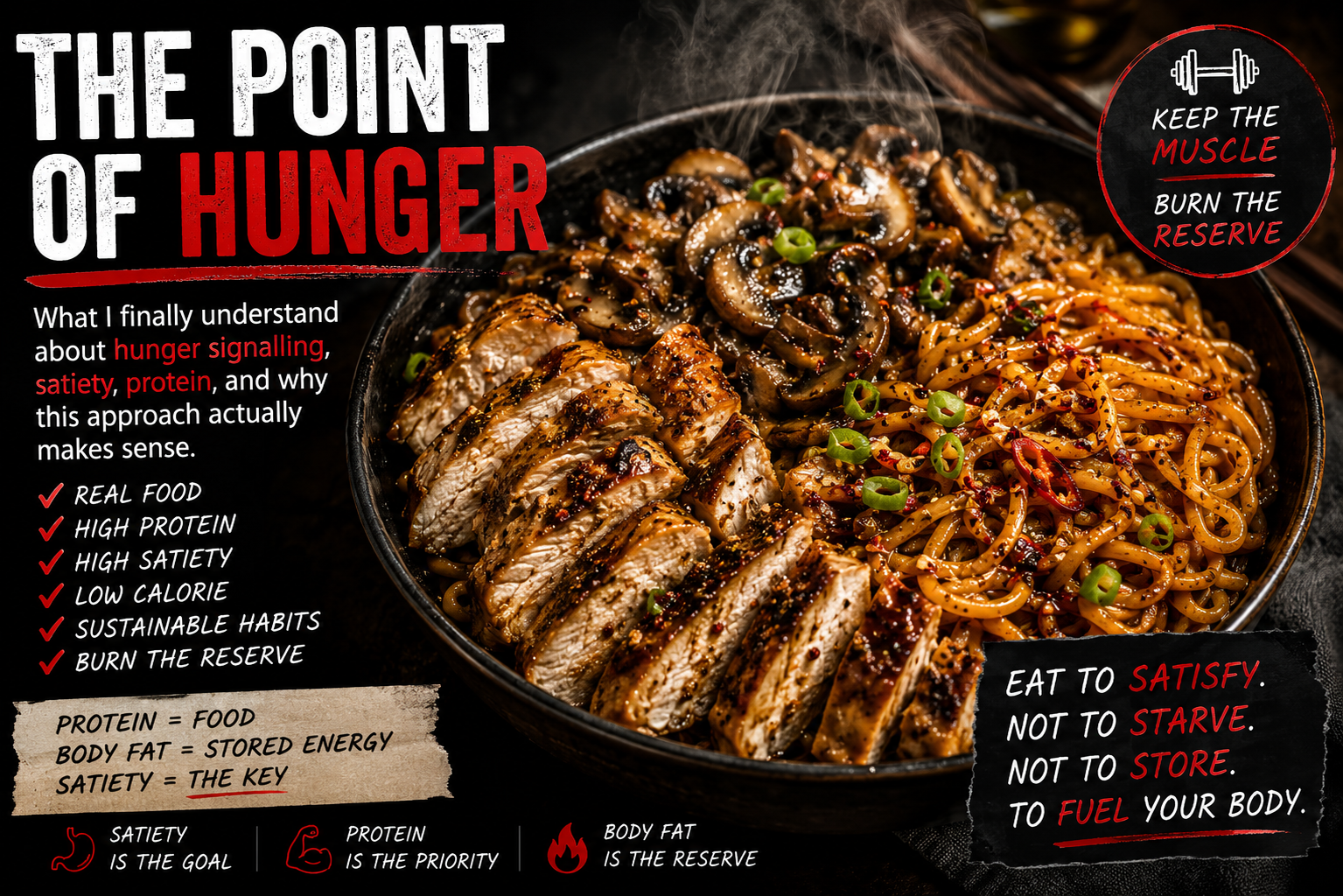
Yesterday’s dinner was:
- around 700g chicken breast
- 300g mushrooms
- 300g chilli noodles
- chilli powder
- low calorie BBQ sauce
That was it.
And the strange part is:
it completely satisfied me.
Nothing else needed afterwards. No grazing. No snacks. No “treat.” No dessert. No feeling deprived.
Just:
hunger resolved.
Not “diet full.” Actually full.
That is when I realized: the goal was never volume by itself.
The goal was:
satiety.
The Difference Between “Healthy” and Satiating
I constantly see “healthy meals” online that are:
- 450–500 calories
- 35–40g protein
- tiny portions
- beautifully presented
And honestly:
I could eat about five of them.
That isn’t criticism of the people making them. For many smaller or leaner people, those meals probably work perfectly fine.
But for someone my size trying to lose fat while preserving muscle: they don’t actually satisfy hunger.
Yesterday’s dinner was around:
- 1,375 kcal
- roughly 190g protein
And that sounds huge until you realize something important:
it completely stopped the hunger.
Not for 45 minutes. Not until dessert.
Actually satisfied.
Which means the meal succeeded at the entire purpose of eating.
That is the part I misunderstood for years.
I thought successful dieting meant:
“eat as little as possible.”
Now I think successful dieting means:
“eat in a way that allows the body to comfortably burn stored energy without constant hunger.”
That is a completely different mindset.
Why I Am Lowering My Ozempic Dose Back To The Minimum
One thing I think is important to clarify is: the reason I started taking Ozempic in the first place was not random cosmetic weight loss.
The medication was helping counteract the ravenous hunger that came as a side effect of Nebido (my hormonal treatment for Klinefelter Syndrome).
And honestly: it worked.
It brought my hunger back down to what felt like normal levels.
At the time, increasing the dose seemed logical because my appetite felt almost impossible to control.
But looking back now, I think I misunderstood part of the problem.
I thought the issue was:
“I am too hungry.”
Now I think the issue was:
“I am eating foods that never properly satisfy hunger.”
Because before this shift in eating style, I could easily consume:
- 2,500–3,000 calories daily
- while only getting around 70–80g of protein
Which sounds completely absurd to me now… but there you go.
That is what highly processed, low satiety eating can actually do.
Huge amounts of energy. Very little actual nourishment. And somehow:
still hungry afterwards.
The Ozempic helped suppress the chaos created by that environment. But now the environment itself has changed.
My meals:
- keep me full
- satisfy hunger properly
- stop food obsession
- make compliance easy
A lot of people look at GLP-1 medications as cheating…
And honestly: I understand why.
Although I think “convenience” is probably more accurate than “cheating.”
Because if your hunger signalling is fundamentally distorted, the game is already rigged.
If you can consume thousands of calories without ever actually feeling properly satiated, then willpower alone becomes a terrible long-term strategy.
The medication helped level that out. It reduced the constant noise. It made compliance possible while I figured out what was actually wrong with how I was eating.
But now I think I finally understand how to play the game properly:
- high protein
- high satiety
- actual food
- meals that genuinely resolve hunger
So instead of increasing the medication forever, I actually want to lower the dose back to 0.25 after my next appointment.
Not because Ozempic “doesn’t work.” Clearly it does.
But because:
the food itself is finally doing what food is supposed to do.
And maybe that means the Nebido cravings themselves eventually become far less relevant once I am no longer trying to maintain a caloric deficit.
For years it felt like my brain was constantly shouting:
“Eat. Eat. Eat.”
But the strange thing is: I never really gave it what it actually wanted. Now I think the answer might simply be:
satiety.
Maybe when the body is properly satisfied, the noise eventually quiets down on its own.
Why People Lose Muscle While Dieting
This also explains something else that finally makes sense to me: why people lose muscle during fat loss.
Most diets are:
- low calorie
- low protein
- low satiety
- low energy
- combined with little or no resistance training
So the body receives a terrible signal:
“Everything is scarce.”
Which means:
- muscle gets sacrificed
- metabolism slows
- hunger increases
- adherence collapses
My current approach is almost the opposite:
- high protein
- walking daily
- rucking
- beginning resistance training
- keeping the muscles active while body fat supplies the energy
The goal isn’t:
“become smaller.”
The goal is:
“keep the muscle… burn the reserve.”
The Biggest Scam In The Supermarket
One thing I have noticed while shopping is how absurd most “high protein” foods actually are.
The processed high protein products:
- cost a fortune
- are still heavily processed
- often aren’t even that high in protein
- are usually tiny portions
- still don’t satisfy hunger properly
Meanwhile:
- tuna
- white fish
- chicken
- offal (liver, kidneys, heart, tongue and tripe)
- lean ham
- jerky
- sardines
- smoked meats
…are cheaper, more filling and actually feel like food.
Turns out the best high protein foods are usually just:
actual protein foods.
Why The Confusion Happens
The hardest part to understand is: processed foods genuinely taste amazing.
That is why this whole thing is so confusing.
Because if something tastes incredible, the brain assumes:
this must be what I need.
But hyper-processed foods are often engineered for:
- repeat consumption
- dopamine response
- easy overeating
- low resistance eating
Not necessarily:
- satiety
- nourishment
- appetite termination
That is why you can eat:
- crisps
- cereal
- junk food
- takeaways
…and still want more afterwards.
Whereas a huge bowl of lean protein, vegetables and fibre can suddenly produce:
“I’m done eating.”
Final Thoughts
A few weeks ago I thought the breakthrough was:
“high protein helps.”
Now I think the real breakthrough is this:
The goal of eating is not:
maximum pleasure or maximum calories.
The goal is:
satiety.
To actually satisfy hunger properly.
Once that finally clicked, everything else started making sense:
- OMAD became easier
- fasting became easier
- food obsession reduced
- weight loss accelerated
- and the idea of maintaining this long term stopped feeling impossible
I don’t think I needed more willpower.
I think I needed food that actually behaved like food.